
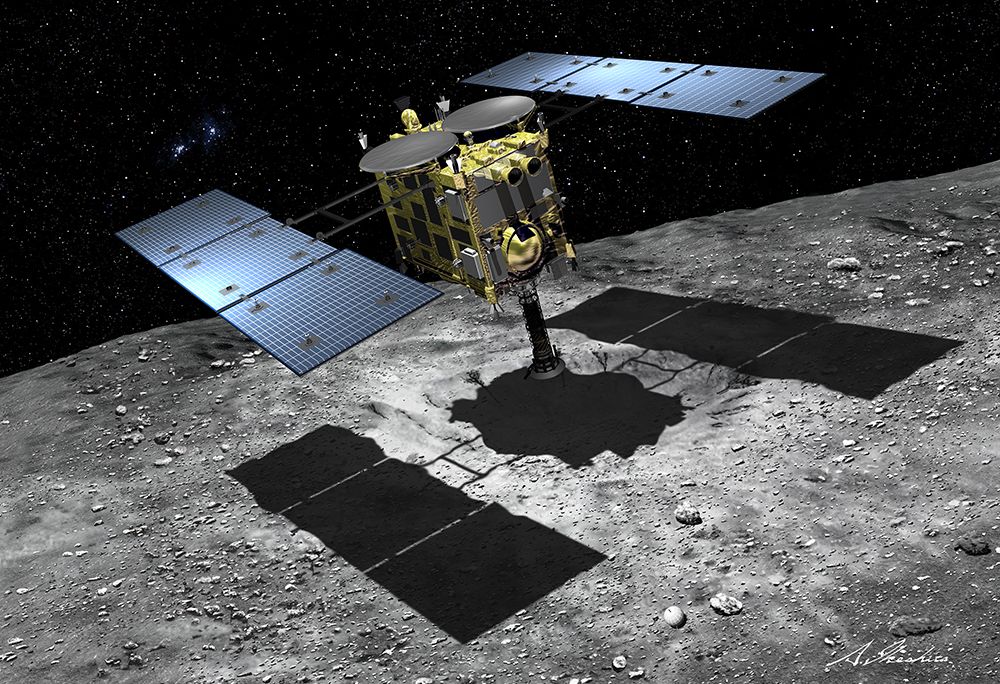
Hayabusa: The Asteroid Hunter Returns
Introduction
Remember that grainy footage from 2010? A tiny spacecraft, battered and bruised, limping its way back to Earth after an incredible, almost impossible mission? That was Hayabusa, Japan’s first asteroid sample return mission. It captivated the world, not just for its daring feat of collecting dust from a distant asteroid, but for its sheer resilience against a barrage of technical malfunctions. Now, the Hayabusa spirit lives on, not just in its successor, Hayabusa2, but in a renewed global focus on asteroid exploration. But why all the fuss about rocks in space? What’s the big deal? And what does it mean for us here on Earth?
Well, buckle up, because the answer is far more fascinating and impactful than you might think.
Why Asteroids Matter: More Than Just Space Rocks
Asteroids aren’t just cosmic debris; they’re time capsules, remnants from the very formation of our solar system. They offer a pristine peek into the ingredients that came together to create the planets, including our own. Studying them is like reading the earliest chapters of our solar system’s history.
But the implications go far beyond scientific curiosity. Asteroids also hold potential resources – precious metals like platinum, nickel, and iron, as well as water, which could be used as fuel or life support on future space missions. Imagine a future where we’re mining asteroids for resources, alleviating pressure on Earth’s dwindling supplies. It sounds like science fiction, but it’s a rapidly developing field known as asteroid mining, and missions like Hayabusa are laying the groundwork for its feasibility.
However, there’s also a darker side to this cosmic equation. Asteroids pose a potential threat to our planet. A large impact could trigger devastating consequences, from regional destruction to global climate change. Remember the dinosaurs? It’s widely believed an asteroid impact played a significant role in their extinction.
Short-Term Impact: Fueling Scientific Discovery
In the short term, missions like Hayabusa and Hayabusa2 are revolutionizing our understanding of the solar system. The samples brought back from asteroids Itokawa and Ryugu, respectively, have already yielded groundbreaking insights into the building blocks of life, the formation of planets, and the distribution of water throughout the early solar system.
For instance, analysis of the Ryugu samples revealed the presence of organic molecules, suggesting that asteroids may have played a role in delivering the ingredients for life to Earth. These findings are not just interesting; they challenge our fundamental understanding of how life arose.
The Hayabusa missions have also spurred significant advancements in spacecraft technology. They forced engineers to develop innovative solutions for navigating in the harsh environment of space, collecting samples from low-gravity environments, and reliably returning those samples to Earth. These technologies are now being applied to other space missions, pushing the boundaries of what’s possible.
Long-Term Impact: Protecting Earth and Expanding Our Horizons
The long-term impact of asteroid exploration is even more profound. Identifying and tracking potentially hazardous asteroids (PHAs) is crucial for planetary defense. We can’t prevent impacts if we don’t know they’re coming. Missions like Hayabusa help us understand the composition and trajectory of asteroids, allowing us to better predict their future paths.
Furthermore, asteroid mining offers a potential solution to Earth’s resource scarcity. As our population grows and our demand for resources increases, asteroid mining could provide a sustainable source of materials, reducing our reliance on Earth’s finite reserves. This could lead to a new era of economic prosperity and technological advancement.
Finally, asteroid exploration is a stepping stone to further exploration of the solar system and beyond. The technologies and techniques developed for asteroid missions will be essential for exploring other celestial bodies, such as Mars and the moons of Jupiter and Saturn.
So, What Can We Do? Practical Solutions for a Cosmic Future
While the idea of deflecting an asteroid or mining one might seem far-fetched, there are practical steps we can take today to support this vital field:
- Support Space Exploration Funding: Governments and private organizations need to invest in research and development of technologies for asteroid detection, tracking, and mitigation. Write to your elected officials, support space-focused initiatives, and let them know you believe in the importance of space exploration.
- Advocate for International Collaboration: Asteroid defense is a global challenge that requires international cooperation. Support initiatives that promote collaboration among space agencies and research institutions worldwide. The more eyes we have watching the skies, the better our chances of spotting potential threats.
- Promote STEM Education: Encourage students to pursue careers in science, technology, engineering, and mathematics (STEM). A skilled workforce is essential for developing the technologies needed for asteroid exploration and defense.
- Engage in Citizen Science: Participate in citizen science projects that help analyze data from asteroid surveys. Even without a scientific background, you can contribute to the search for PHAs. Projects like Zooniverse offer opportunities for anyone to get involved.
- Stay Informed: Keep up to date on the latest developments in asteroid exploration and defense. Read articles, watch documentaries, and follow space agencies and researchers on social media. The more informed you are, the better you can advocate for the importance of this field.
Alternative Approaches: Diversifying Our Options
Just as there’s no single type of asteroid, there’s no single solution to the challenges they present. Here are a few alternative approaches:
- Kinetic Impactor: This involves sending a spacecraft to collide with an asteroid, altering its trajectory. NASA’s Double Asteroid Redirection Test (DART) mission successfully demonstrated this technique, proving it’s a viable option for deflecting asteroids.
- Gravity Tractor: This involves stationing a spacecraft near an asteroid and using its gravitational pull to slowly nudge the asteroid onto a new course. This method is slower but potentially more precise than a kinetic impactor.
- Laser Ablation: This involves using high-powered lasers to vaporize material from the surface of an asteroid, creating a thrust that gradually changes its trajectory. This technology is still under development, but it holds promise for future asteroid deflection missions.
The Future is Upward: Embracing the Cosmic Frontier
The story of Hayabusa is a testament to human ingenuity, resilience, and the boundless potential of space exploration. It reminds us that even the most audacious goals are achievable with dedication, innovation, and international collaboration.
The challenges posed by asteroids are real, but so are the opportunities. By investing in research, promoting STEM education, and fostering international cooperation, we can protect our planet, unlock the vast resources of the solar system, and expand our horizons beyond Earth.
The future of humanity is not confined to our planet. It extends to the stars, and asteroids are a crucial stepping stone on that journey. Let’s embrace the challenge, support the scientists and engineers who are pushing the boundaries of space exploration, and work together to create a future where humanity thrives among the stars. The legacy of Hayabusa is not just about collecting rocks from space; it’s about inspiring us to reach for the stars and build a brighter future for generations to come.